
• Skip to primary navigation
  • Skip to main content
  • Skip to primary sidebar
Average But Inspired logo - DIY and craft

Average But Inspired

Craft a home you love. DIY and craft tutorials.

  • About
    • Contact Me
    • Disclosures
    • Privacy Policy and Copyright Policy
  • DIY
    • Furniture
  • Crafts
    • Dollar Store Crafts
    • Seasonal
      • Patriotic & Summer
      • Valentine’s Day
      • Easter & Spring
      • Fall & Halloween
      • Christmas & Winter
  • Home Decor
    • Organization
  • Shop
    • DIY Guides
  • Home

Furniture

How I Painted Fabric Chair Cushions Instead of Reupholstering

May 5, 2026 by Bre Leave a Comment

When I spotted this chair at my local Habitat ReStore, I knew it had good bones. But the fabric? Let’s just say it was giving the Golden Girls‘ living room. Bold floral upholstery that was not exactly my style.
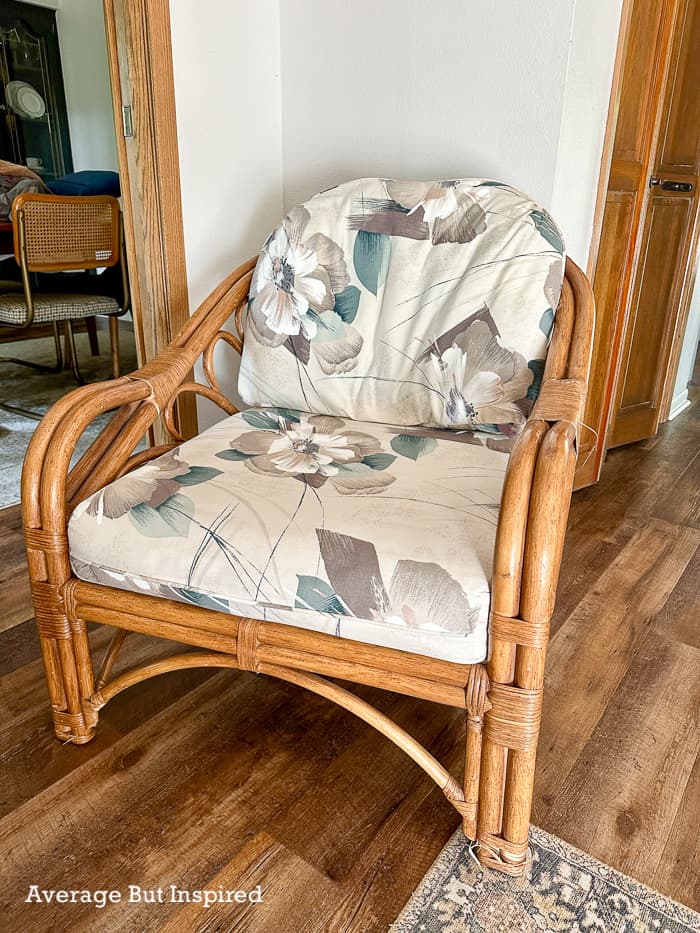
BEFORE: a 1980's style cane chair with floral fabric upholstery was in need of a refresh. Painting the fabric cushions was all it took.

The typical solution would be to reupholster the cushions, but that’s time-consuming, can get expensive, and honestly, I wasn’t sure it was worth it for a thrift store find. So I decided to try something I’d been curious about: painting the fabric directly.

Two years later, I’m so glad I did.

Upholstery Painting Supplies

This post contains affiliate links. Please read my disclosure policy for more information.

  • Chalk paint (in your color of choice)
  • Fabric paint medium
  • Chalk paint brush
  • Extra fine grade sandpaper
  • Spray bottle with water
  • Iron or heat press
  • Mixing cup and stir stick

How to Paint Seat Cushions

Painting fabric upholstery like this is actually pretty easy. I will walk you through each step so you can try it if you like.

Wash the cushion covers

If you can get them off, wash the cushion covers in the washing machine. If they’re not able to be removed, spot clean and vacuum them.

Mix your paint

Combine your chalk paint (any brand works!) with the fabric medium, according to the medium’s instructions.

The fabric medium is the key to this entire project. It keeps the dried paint flexible so it won’t crack or feel stiff when you sit on it.

Fabric painting supplies for painting fabric seat cushions.

Apply your first coat

Spritz the fabric with a light coat of water, and then paint your first coat of paint onto the cushion fabric. Work the paint into the fibers as you go, and don’t worry if it looks a little rough at this stage. That’s normal. Let it dry completely.

Painting fabric seat cushions

Sand lightly

Once the first coat is fully dry, take your extra fine grade sandpaper and lightly sand the surface. This knocks down any stiff or raised fibers, and gives you a much smoother finish on the second coat. Wipe away any dust before moving on.

Repeat the painting, drying, and sanding process

Yep, do it all again (and maybe even again) until you get the paint coverage you want.

First coat of painted upholstery with chalk paint and fabric painting medium.

I stopped at two coats. I liked that some of the large, white flowers peeked through instead of a totally solid color.

Heat-set with an iron

Once everything is dry, heat-set the paint using an iron (or a Cricut heat press like I used). This step helps lock in the paint and makes it much more durable over time.

Use a pressing cloth if needed to protect the surface, and follow the guidance on your fabric medium for temperature settings.

Heat setting painted upholstery helps the fabric paint medium last for a long time.

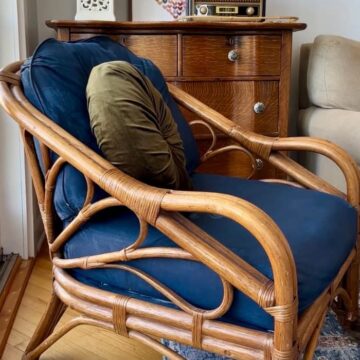
That’s it! The whole process is surprisingly simple, and the results are genuinely impressive. My chair cushions have held up beautifully for two years now with no cracking, no peeling, and they’re still comfortable to sit on.

Painted fabric chair cushions brought new life to a thrifted chair.

If you’ve got a piece of furniture you love the shape of but can’t stand the fabric, this method is absolutely worth trying before you commit to a full reupholster.

A rattan chair got new life with painted cushions and upholstery.

Have you ever painted fabric furniture? I’d love to hear how it turned out in the comments!

Filed Under: DIY, Furniture Tagged With: Painted Furniture

Vintage-Look Green Painted Table for a Cottage Bunk Room

February 20, 2025 by Bre 2 Comments

blank

A hand-me-down table got a new, old look with kelly green paint and distressing.

I love having friends who think of me for their furniture castoffs. I am the designated collector of junk, after all.

Recently my friend, Megan, passed along this little vanity that her daughter no longer used.

BEFORE: a mint green painted vanity table was given to Bre to refinish.
BEFORE: the vanity table was painted with mint green gloss paint.

This post contains affiliate links. Please read my disclosure policy for more information.

While I have no need for a vanity (let’s just say I’m pretty low maintenance), I did have a need for a small desk at the lake cottage.

Although I really don’t want people working there, I know there will be times someone needs to do homework or send an email. So I decided this piece would become the designated work spot.

And while it was cute with its glossy mint green paint, it wasn’t exactly the look I needed. I felt that a distressed painted finish in a vintage kelly green color was the direction we needed to go.

The Vintage Table Makeover

I started by stripping the gloss paint off with this low-odor paint stripper. Within thirty minutes most of the paint on top was bubbled and ready ready to come right off.

Low odor furniture paint stripper worked quickly to soften the paint for removal.

The paint scraped off very easily on the top, but on the legs it was as if the paint stripper had started to freeze!

The mint green paint removed easily from the top of this vanity.

I brought the table inside and wiped it down with mineral spirits to get the remaining paint stripper off, and then I took the table to the garage to sand it.

Check Out More Of My Furniture Makeovers!

Since I wanted a vintage look, I wasn’t concerned about removing all of the paint. I didn’t expect the table legs to look so awful though! They were definitely paint-grade wood and not meant to be stripped and re-stained.

Oops.

This table looked terrible once all of the paint was removed! The paint-grade wood on the legs was in very rough shape.

Oh well. I carried on and found the most perfect shade of vintage kelly green chalk paint at Michaels.

I applied a coat with a round paintbrush and then used my orbital sander with 220-grit sandpaper to remove some of that first coat of paint.

Using an orbital sander to remove some of the kelly green paint on the table helped to give it a distressed or vintage look.

I took off a little too much paint, so I dry brushed on another coat of green. Once I that second coat of paint dried, I applied a thin layer of clear wax to the table to help protect the new paint job.

This wax isn’t my favorite furniture wax, but it’s pretty good. I like to use it when I’m working indoors because it has no odor at all.

This clear wax was used to help seal the painted table.

I then added new hardware to the drawer (it was actually the hardware from a 1927 window in our old home), and blue gingham cardstock to line the drawer.

Blue gingham paper lined the drawers of the newly-refinished vintage green desk.

The Vintage-Look Green Painted Table

This newly-made over desk or table fit perfectly in front of the window in one of the cottage bedrooms.

A lake cottage bedroom with bunk beds and a vintage-look green painted table desk.

The distressing on the finish is just what this piece needed.

This table or desk has a vintage look with kelly green paint in a distressed finish, blue gingham drawer liner, an antique brass window pull as the drawer pull, and overall charm.

And the kelly green reminds me of a color you’d see used in an old cabin. I think it’s so charming!

A small vintage green desk in a cottage bunkroom.

I love how it turned out and I’m thankful it was the perfect size for this cozy cottage bedroom.

This new table was distressed and painted in a vintage green paint to make it look old for this lake cottage.

What do you think of it’s new look? Can it pass for an old table?

Filed Under: Furniture Tagged With: Cottage, Painted Furniture

DIY Teak Table Restoration: a Roadside Rescue

October 29, 2024 by Bre 7 Comments

DIY teak wood table restoration

I’m sharing my process for a DIY teak table restoration. It’s easy, though time-consuming, and totally worth it!

I kept driving by this table on the side of the road, wondering why nobody had scooped it up.

Maybe because it looked to be in pretty rough shape? Maybe because it was too unwieldy to stick in the trunk?

BEFORE: this outdoor teak table was on the side of the road for free

Whatever the reason was, I was glad they didn’t take it! My husband and I brought it home so I could fix it up to take to our cottage, where we need another outdoor table.

I planned to sand, stain, and seal it. But as I examined the table, I noticed this gold plaque on the bottom, which read “Kingsley-Bate Genuine Teak Furniture.”

This teak table was made by Kingsley-Bate

Upon Googling this, I found out that this exact table retails new for $1600! I also found out that my makeover plans were NOT the right plans – ha! Teak wood required a much different approach.

Supplies Needed to Restore Teak Wood Furniture

This post contains affiliate links. Please read my disclosure policy for more information.

  • Teak Wood Cleaner
  • Teak Wood Oil
  • Chip brushes
  • Heavy-duty scrub brush
  • Lint-free rags
  • Hose
  • Disposable cup
  • Gloves
  • Optional: orbital sander and 80-grit sandpaper

How to Restore Outdoor Teak Furniture

This table was in pretty rough shape. The gray color of the teak, the roughness and deep grooves in the wood, and lichen and moss growing all over make me think it was not well cared for.

The outdoor teak was in very rough shape. It had a dark gray patina and was growing moss and lichen

Apparently, teak is super durable (and that’s why it’s loved for outdoor furniture), so I figured I could get it looking much better than how I found it.

Step One: Clean the Teak

I purchased teak cleaner because this table was . . . disgusting.

I applied the cleaner with a chip brush and let it sit for about fifteen minutes. After that, I scrubbed it in the direction of the grain with a heavy-duty scrub brush.

Applying teak cleaner and scrubbing with a heavy-duty scrub brush was the first step in restoring the teak table.

I was AMAZED at how much junk came off the table, and how the brown tones of the teak wood were already showing through!

Scrubbing the teak cleaner off resulted in piles of debris.

I worked in small sections so that the teak cleaner didn’t dry on the wood before I had a chance to scrub it.

After I finished scrubbing, I hosed the table down to rinse off all the debris left behind by the scrubbing process.

Step Two: Let the Teak Dry Completely

Next, it was a waiting game. I let the teak dry for over 24 hours before moving on to the next step.

You May Also Like This Post

How to Refinish Outdoor Wood Furniture

Step Three: Lightly Sand (if Necessary)

This teak wood was so weathered that it was very rough and had deep grooves.

Because of this, I decided to gently sand it with my orbital sander and 80-grit sandpaper.

Because the teak was in such rough shape, a light sanding with 80 grit sandpaper helped remove the roughness.
The right edge is sanded, the left edge is unsanded.

I was very careful not to oversand, as I read that doing so could prevent the teak oil from saturating the wood. Because of that, many of the grooves remain in the wood, but it is smooth to the touch and will not give splinters!

After sanding, I brushed off all the dust (and there was a lot of it).

Step Four: Apply Teak Oil

This part was SO exciting! I applied a thin coat of teak oil to the wood, and it instantly made it shine!

Half of the table has teak oil applied; the other half does not

I again worked section-by-section, and waited about 15 minutes to wipe off any oil that hadn’t sunk into the wood.

After a couple of hours, I applied a second coat of teak oil because I knew this table was VERY thirsty. And, I again wiped off the oil that didn’t sink into the wood after fifteen minutes or so.

Once the teak oil seeped into the wood, shades of brown and gray appeared

The Outdoor Teak Table Restored

The teak continued to absorb the oil overnight, and it was ready to go the next day!

I love the blend of browns and grays in this teak wood table. It’s just beautiful, and I feel so lucky that it’s mine!

This DIY teak table restoration turned out beautiful! This outdoor table has lots of life left in it.

To maintain it going forward, I will apply more teak oil as it starts to look weathered. I do plan to cover it when not in use, so that should help with protecting it, too.

Now I just need to get some chairs and a cute umbrella!

Filed Under: DIY, Furniture

How to Remove Stinky Smells from Wood Furniture

August 20, 2024 by Bre Leave a Comment

blank

Looking for a way to remove odors from wood furniture? This post will teach you the way I get rid of stinky smells from antiques!

I know you know – you find the PERFECT piece of furniture at the thrift store. You excitedly pay a bargain price for it and then get it home, only to discover that it doesn’t smell nearly as good as it looks.

Old furniture stink. It’s a thing, my friends!

Is it the smell of stale cigarettes? Grandma’s basement that nobody’s been in for 34 years? Cats? All of the above? Nobody really knows.

But thankfully it’s not too difficult to eliminate odors from wood furniture. And, you probably have several of the supplies in your pantry already!

Want to remove odors from wood furniture? This post teaches you how to get stinky smells out of wood - fast! Cigarette smoke, stale smells, mildew smells, and more!

This post contains affiliate links. Please read my disclosure policy for more information.

How to Get Smells Out of Old Wood Furniture

So . . . let me guide you through my process for getting the smell out of furniture. Of course there are other ways of doing this, and other products you could use, but this is the way I do it.

Step One: Clean the Furniture

You have to start by cleaning the furniture.

I like to use Krud Kutter because it’s a gentle, non-toxic cleaner that doesn’t leave behind any residue. Because of that, it’s perfect for using on pieces that are going to be painted or left as natural wood.

Before removing odors from wood furniture, you need to clean the furniture.

If you’re not planning to paint the furniture, you could also wash it with Murphy’s Oil Soap – a classic!

Step Two: Wipe Smelly Furniture with a Vinegar Mix

Next, at a 1:1 ratio, mix vinegar and water. (Note: I used grocery store 5% acidity vinegar, but if you have access to a higher acidity vinegar, that will work great!)

Gently wipe down the furniture with this mixture, taking care not to oversaturate it.

A vinegar and water mix is an effective way to remove odors from the surface of wood furniture.

I know vinegar is a little stinky, but it works wonderfully for removing furniture odors that linger on the surface of the piece after cleaning!

You Might Find These Other Furniture Posts Helpful, Too!

  • How to Make Homemade Chalk Paint
  • How to Fix Bleedthrough When Painting Furniture or Cabinets
  • Gel Stain Tips & Tricks

Step Three: Apply Baking Soda to the Wood Furniture

Open a new box of baking soda (not that one you’ve had sitting in the back of your fridge for eight months), and sprinkle it all over!

The insides of drawers are a perfect place to sprinkle baking soda, and you can also apply it to the tops of dressers, tables, etc.

As much as you can, work it into the wood. Then let it sit for several days. It will absorb odors in the wood furniture.

When you’re ready to be rid of the baking soda, vacuum as much of it up as you can. Then use a damp rag to wipe away the rest of it.

Baking soda is a great odor absorber! Sprinkle it into drawers or on table tops and let it sit to absorb stinky smells.

Step Four: Apply a Furniture Salve

Finally, this last step will not only help the furniture smell great, but it will also revive the wood.

Apply a scented furniture salve (like this lemon furniture salve I use), to parts of the wood furniture that will NOT be repainted or stained. So – you may want to use it inside of drawers, on the edges of drawers, etc.

Use a scented furniture salve to rehydrate wood furniture and give it a pleasant scent.

The salve hydrates the wood, which gives it a nice shine and depth. It also helps replace any lingering odors with a pleasant scent.

Other Products To Remove Odors from Wood Furniture

If this sounds like too much work for you (no judgment), there are products on the market that claim to remove odors from wood furniture. I haven’t tried them, but they get good reviews! So, I thought I’d pass them along just in case they help.

Also – always remember to spot test first! You don’t want to ruin any furniture with these products.

Zep Smoke Odor Eliminator

This says it can be used on wood furniture to remove cigarette smell. The reviews mention using it in drawers especially!

Zero Odor Pro

This is a commercial-grade odor remover product. It claims to remove the most stubborn of smells, so if you’ve got a really stinky piece, it might be worth checking out.

Charcoal Odor Absorbers

These charcoal odor absorbers not only take care of stinky smells (like in drawers), but they also remove any moisture in the furniture that might be contributing to odor.

***

Remember, friends don’t let friends live with stinky furniture, so share this post with anybody who might find it useful!

Filed Under: Furniture

Foyer Table Makeover with Homemade Chalk Paint

May 8, 2024 by Bre 11 Comments

blank

Looking to make your own chalk paint for furniture painting? Try this calcium carbonate chalk paint recipe!

This post was first published in 2013 and updated in May 2024.

I am officially on the chalk paint bandwagon.  In fact, if I could, I would drive that wagon.  I am obsessed.  

I am already thinking about my next chalk paint project, but for now, here’s a before and after of my first.

Homemade calcium carbonate chalk paint is a great way to make your own chalk paint and spend a fraction of the price of store bought chalk paint.
Please excuse the bad photos. They are from 2013 when I first started blogging!

This all began a few weeks ago when my husband was in Las Vegas for his fantasy football draft.  (Yes, I banked about five gazillion points for this one).  With the kids in bed and nobody to talk to, I decided to go on a Pinterest binge.  

Some amazing chalk paint projects caught my eye that night, so I decided to watch a few tutorials on YouTube about how to use the name brand chalk paint, Annie Sloan.  After that, I researched the product and found that it is pretty expensive.

This seemed strange to me because last year, my mom gifted me with some gorgeous chairs that she had refinished with chalk paint, and my mom is not the type to spend a ridiculous amount of money on paint or supplies.  

Perplexed, I called her and found out that YOU CAN MAKE YOUR OWN CHALK PAINT (as she did for my chairs)!  Add this to the long list of reasons why my mom is amazing.

So anyway, I did some more research and found that there are a few recipes for homemade chalk paint floating around: calcium carbonate chalk paint, Plaster of Pairs chalk paint, and unsanded grout chalk paint.

I decided to try making calcium carbonate chalk paint, and that’s what I’ve been using ever since 2013.

Chalk Paint Recipe Calcium Carbonate

This post contains affiliate links. Please read my disclosure policy for more information.

To make your own chalk paint with calcium carbonate, here’s what you’ll need:

  • Flat or matte latex paint
  • Calcium carbonate
  • Water
  • Measuring cup
  • Measuring spoon
  • Mixing spoon
  • Container

To make up a batch of this chalk paint, simply mix 2/3 cup of flat latex paint with 1/3 cup of calcium carbonate and 1 tablespoon of water.

Stir the ingredients together and make sure that all of the calcium carbonate clumps have dissolved. If they are not dissolving or the paint mixture seems too thick, you can add another tablespoon of water to thin it out a bit.

You Might Like These Other Paint-Related Posts!

  • 5 Ideas for Leftover Paint Samples
  • Spray Chalk Paint Review

Important Things to Know About Painting with Homemade Chalk Paint

Making your own chalk paint is a great way to save money and get specific paint colors in chalk paint form! There are a few important things to know though.

The Price of Calcium Carbonate

First, you might think that the price of calcium carbonate is too expensive. Just remember that a bag of calcium carbonate will make so much chalk paint! Depending on how much painting you do, you could have enough calcium carbonate to last you years.

Make your own chalk paint for furniture painting with calcium carbonate! The best DIY chalk paint recipe is in this post.

Calcium Carbonate Chalk Paint Prep Work

Next, the best thing about chalk paint, in my opinion, is that the only prep work involved is mixing your paint.  You don’t need to sand the furniture, prime it or anything!  I always want to get right to it, so eliminating the tedious prep work is fantastic.

That being said, it is important to make sure the piece is clean. And, I do recommend a gentle scuff sand before painting any surface! It’s better to rough up the surface a bit to help give the paint more to hang onto.

When Making Chalk Paint, Mix it Well!

On my first homemade chalk paint project, I didn’t mix the paint and calcium carbonate enough, so I had little white bumps all over the place.  It looked really bad.  

Make sure to mix homemade chalk paint so that there are no white bumps left in the paint.

When making calcium carbonate chalk paint, make sure to mix it well!

And, if you do happen to get some calcium carbonate bumps in your finish, you can gently sand them off (once the paint is dry). Then, remix the paint and apply a second coat of paint.

What to Seal Calcium Carbonate Chalk Paint With?

Finally, make sure to properly seal any piece that you paint with calcium carbonate chalk paint! It will chip right off if you don’t do this correctly.

Furniture painted with calcium carbonate chalk paint is beautiful.

My favorite sealer to use was S.C. Johnson Paste Wax, but it is no longer being made! Apparently a great alternative is Minwax Paste Finishing Wax. I have not tried that product though.

Alternatively, I like to use polycrylic in a flat finish to create a very durable but matte piece.

***

Since the time I first wrote this post, I’ve completed dozens of furniture makeovers, and I never hesitate to use my trusty calcium carbonate chalk paint recipe. It is really great and I think you’ll love it, too!

Filed Under: Furniture

Refinish Outdoor Wood Furniture: A Step-by-Step Guide for a Stunning Makeover

June 1, 2023 by Bre 3 Comments

blank

Has your outdoor furniture seen better days? Learn how to refinish outdoor wood furniture in three simple steps! Your patio furniture will never look better.

I know you’ve been there: the warm weather finally hits and you’re pumped to spend time outside.

But when you head out to relax, you realize your outdoor furniture has seen better days.

What once was beautiful wood furniture adorning your patio is now gray, cracked, and faded. (Hmm . . . funny how outdoor wood furniture ages the same way I am. Ha!)

Don’t despair: there’s hope! And, the good news is that refinishing wood furniture is likely to be so much easier than you think!

In just three simple steps, you can restain outdoor wood furniture and make it look brand new once again!

Learn how to refinish outdoor wood furniture in three simple steps! You can make gray, dry, and cracked outdoor wood look new again.

Supplies Needed to Refinish Outdoor Wood Furniture

This post contains affiliate links. Please read my disclosure policy for more information.

These are the outdoor wood furniture refinishing supplies I use and recommend. Of course you can supplement as you see fit!

  • Exterior wood stain and sealer (I recommend buying a stain with a sealer built in. More on that later in this post)
  • Stain brush or chip brush
  • Paint stir stick
  • Rubber gloves or disposable latex gloves
  • Sandpaper
  • Clean cloth, clean rag, cotton rag, and/or tack cloth
  • Optional: electric sander (like an orbital sander)

How to Restain Outdoor Wood Furniture

For this tutorial, I’m refinishing the outdoor wood bench that I purchased to use near my DIY Fire Pit at my old home.

The photos in that blog post show the bench when it was brand new. It was stained solid black and in perfect condition.

After five years in the direct sunlight and harsh Illinois and Wisconsin winter conditions, the bench looked like this.

BEFORE: an outdoor wood bench was sun and water damaged before she refinished it with exterior wood stain.

Totally grayed out and starting to crack in places, it was time to freshen it up!

Got Teak Wood? You’ll Want This Post!

How to Restore Outdoor Teak Wood Furniture

Clean the Outdoor Furniture Well

The first step in this wood furniture refinishing journey is to clean the piece well.

“Clean well” will mean different things for different pieces.

For example, cleaning this bench consisted of me wiping it down with a paper towel. I made sure to brush off all the pollen and get it as clean as I could with just that towel.

When refinishing outdoor wood furniture, the first step is to clean the furniture well.

If your wood furniture piece has things like bird poop, mildew, or algae on it, however, you’ll need to clean it better. I recommend hosing it off with a jet sprayer attachment, or using a soft wash pressure washer if you have one available.

If using water to clean the furniture, make sure to give it plenty of time to dry completely (in a covered space, preferably), before staining.

Sand the Wood Furniture (maybe!)

Next, it’s time to sand the outdoor furniture piece . . . maybe. (I know you’re hoping you don’t have to!)

In the case of my outdoor bench, I stained it with a solid exterior stain in the same color (or slightly darker color) as the original. Because of that, I wasn’t concerned with the preexisting black stain on the bench. I knew the solid stain in the same color would blend with it.

With that in mind, there are two times I recommend sanding before restaining outdoor wood furniture.

Sand Flaking Paint, Cracking, and Rough Spots

The first is if your piece has flaking paint, is cracking, or has rough spots that might give people splinters or other injuries.

In this case, you’ll want to sand in order to create a smooth surface give the new stain an even wood surface on which to adhere. You can try hand sanding, but if the furniture is in rough condition, you may need to switch to an electric sander.

Sand Before Applying Lighter Stain

The next is if you’re using a semi-transparent exterior stain (as opposed to a solid exterior stain), or if you’re staining the wood a lighter color than it currently is.

In both of these scenarios, the original stain color will show through the new stain color if you don’t sand to remove it.

If you do stain, make sure to remove all sanding dust once finished. You don’t want to work dust into your new stained finish.

Stain the Furniture Surface

The next (and final) step is where the outdoor furniture refinishing magic happens!

While wearing gloves (unless you enjoy a stain-colored manicure), apply a thin coat of exterior wood stain and sealer to your wood furniture piece.

Follow the grain of the wood, and apply it in long, even strokes.

To refinish outdoor wood furniture, apply long strokes of exterior wood stain in the direction of the grain.

Depending on the condition of your patio furniture, you may need to apply more than one coat. In that case, follow the manufacturer’s recommendations and directions on the stain you purchased.

I used Behr Solid Color Waterproofing Stain and Sealer and only needed one coat. I really liked this exterior stain product because unlike its oil based stain competitors, this product had virtually no odor and cleaned up very easily.

It also covered really well and hid a lot of imperfections due to the solid color. Finally, it waterproofs wood furniture and protects it from UV rays. Since the sealer is built in, it saves a lot of time, too!

Behr Solid Color Waterproofing Stain and Sealer in Slate was used to refinish an outdoor wood bench.

After the stain is applied, let it dry completely. Make sure to keep it out of the rain or wet conditions for the time recommended on the stain product used (in my case it was four hours).

Maintaining Outdoor Wood Furniture

Once you get your outdoor wood furniture looking good again, it’s easier to maintain it than to refinish it every few years.

There are a few ways to do this, and you can choose what works best for you!

One option is to use heavy-duty outdoor furniture covers when the outdoor furniture is not in use. I use these on my outdoor patio set, and while I find it annoying to take off the covers, store them, and put them back on, they have extended the life of my furniture.

Another option is to apply a transparent sealing topcoat to the wood furniture once a year (or more, if local conditions call for it – like if the furniture gets a lot of direct sunlight or you live on the coast).

And finally, a product I love and use on the wood chairs on my front yard patio is Howard Sun Shield Wood Conditioner and Protectant. This product wipes on and makes old wood look hydrated and lively again. It also contains UV protectant, so it’s great for maintaining outdoor furniture easily.

***

I hope this guide on how to refinish outdoor wood furniture in three simple steps was helpful to you! Please comment below with any questions, and to share your success story!

AFTER: this outdoor wood bench was refinished and looks good as new!

Filed Under: DIY, Furniture

  • Page 1
  • Page 2
  • Page 3
  • Interim pages omitted …
  • Page 8
  • Go to Next Page »

Primary Sidebar

Let’s Connect!

Hi, I’m Bre! Thanks for visiting Average But Inspired, where I show you how to work with what you’ve got to create a home you love.

Bre of Average But Inspired - a DIY and craft blog

Love DIY? Subscribe to Get Posts E-mailed!

How Can I Help You?

blank

Limewash Stone Fireplace Makeover: Bye Bye Orange Stone Fireplace, Hello Neutral Stone Beauty!

blank

How to Paint a Countertop to Look Like Marble!

blank

My DIY Kitchen Makeover Reveal!

blank

How to Paint Over Tile

Looking for Something?

Copyright © 2013-2022, Bre Eggert (Average But Inspired). All rights reserved.
  • Home
  • DIY
  • Crafts
  • Home Decor
  • Privacy Policy and Copyright Policy
  • Disclosures
  • Contact Me